Top Stories
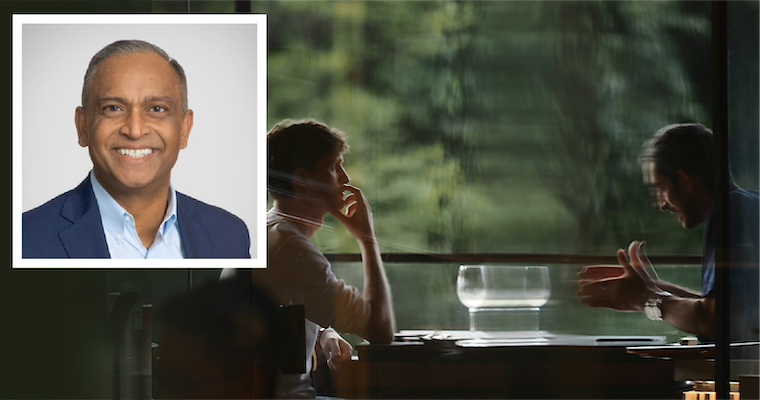
Across the Table: Roy Maharaj, Global Chief Licensing Officer at Ericsson
A 1993 Leavey finance graduate, he has spent three decades negotiating some of the technology industry’s largest patent deals. The work, he says, still comes down to people.
When Ericsson takes a smartphone maker to court over its patents, the cases can run in as many as 13 countries at once. Lawyers work through the filings, and each court keeps its own calendar. Meanwhile, Roy Maharaj is often on a plane, on his way to sit down with the people on the other side.
“It’s a belly-to-belly business,” he says. He picked up the phrase from a mentor, and his team has heard it many times since. As Ericsson’s Chief Licensing Officer for IPR and Licensing, Maharaj leads the group, based in Plano, Texas, that licenses one of the strongest patent portfolios in cellular technology. Ericsson was founded in Stockholm 150 years ago and spends $4 billion to $5 billion a year on research and development. Its licensees include Apple, Samsung, and the leading Chinese handset makers Oppo, Xiaomi, among many more.
Licensees rarely come to the table willingly. As Maharaj describes it, their incentive is to resist, delay, and even litigate as a means of holding out and delaying payment to create negotiation leverage before ultimately reaching a settlement. So the job is less like conventional deal-making than shuttle diplomacy: he travels, listens, carries arguments back to Ericsson’s leadership, and slowly builds an agreement both sides can sign.
Two Negotiations at Once
The deals are large enough that boards and CEOs on both sides must approve them. That means every negotiation has two parts, Maharaj says: the external sale to the licensee, and a quieter internal sale to his own company. Much of his work is timing. He decides when to step in, when to let the lawyers run their track, and when a meeting in person will do more than another round of filings.
The adversarial setting hasn’t kept him from forming lasting and rewarding relationships with the people he negotiates against. He compares it to an old Looney Tunes cartoon in which a sheepdog and a wolf greet each other on the way to work. “One guy’s got to go steal the sheep and the other guy’s got to prevent it. And so we joke that we’re those two guys.”
The approach has paid off. In the near-decade since Maharaj joined Ericsson, the company’s licensing revenue has more than doubled. In 2024, Ericsson posted its highest-ever recurring licensing revenue. In 2025, total licensing revenue reached SEK 14.5 billion (about $1.5 billion), the company’s best year on record.
A Finance Major Finds His Field
Maharaj’s family history runs through a different kind of contract. His ancestors were brought from India to Fiji as indentured servants, and for generations the family lived in poverty. They eventually emigrated to the United States, and Maharaj grew up keenly aware of what that journey had cost them. Their experience, he says, shaped him early.
He became the first in his family to attend college, and he approached it practically. At Santa Clara University’s Leavey School of Business, he majored in finance because it seemed the most direct route to a well-paying job and a way out of the hardship his family had known. Instead, he found “a series of doors and opportunities being opened.” The first was an internship at IBM in San José during his junior year. “It was super competitive, and somehow I was blessed with that opportunity,” he says. IBM kept him on through his senior year and, after he graduated in 1993, hired him full-time in technology licensing and business development. He has worked in that field ever since.
He saw early that a licensing executive who understood both the business and the law would have an advantage. While working at IBM, he earned an MBA from San José State University. He then enrolled at Santa Clara University School of Law and finished a JD in intellectual property law in 1998. He persuaded IBM to pay for it, taking classes at night while continuing to work full time.
The next stage of his career gave him something his degrees had not: sales leadership. At SafeNet, he spent seven years as vice president of global licensing, OEM sales, and business development, running worldwide teams that sold chips, systems, software, and IP licenses. Managing a sales organization was a different discipline from licensing. It proved useful later, in negotiations where the hardest sale was often the internal one.
He went on to lead IP licensing at Alliacense. He then became vice president of licensing at Intellectual Ventures, the firm co-founded by former Microsoft chief technology officer Nathan Myhrvold, where he ran licensing campaigns across a portfolio of roughly 50,000 patents. In May 2017, he joined Ericsson as Chief Licensing Officer.
What AI Won’t Change
Maharaj now advises newer companies in the field. In December 2025, he joined the advisory board of Patlytics, an AI-powered patent intelligence platform, where he brings his experience in business strategy, pricing, and market positioning. AI is compressing patent analysis and portfolio work that once took months into hours, and he welcomes it. He is also clear about where it stops. Deals still depend on trust and judgment, and on relationships built across a table, or over a drink after a long day of talks.
He makes the same point in the classroom. As an adjunct at Arizona State University’s Sandra Day O’Connor College of Law, where he was long a guest lecturer, he teaches what the casebooks leave out: how international deals actually come together, how cultural differences shape a negotiation, and what to do when talks go sideways. For someone who was the first in his family to set foot in a college classroom, teaching is also a way of opening doors for others, the way they were once opened for him. The patents matter, he tells his students. But the deal gets made by the people on either side of the table.