Top Stories
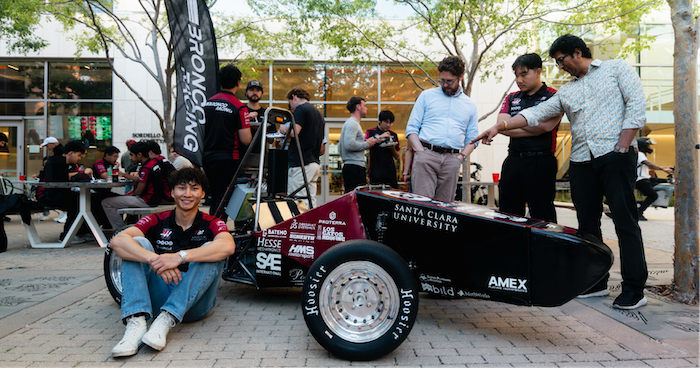
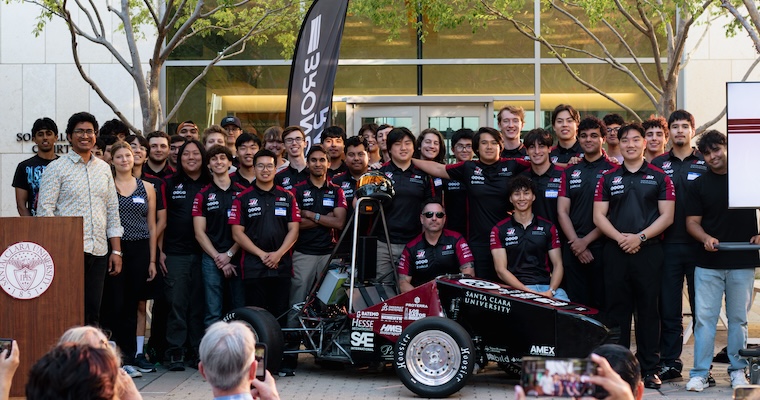
The Bronco Racing Team Builds a Car — and Future Leaders
Now in its second year of competition, this student club combines engineering and business smarts to solve real-world challenges.
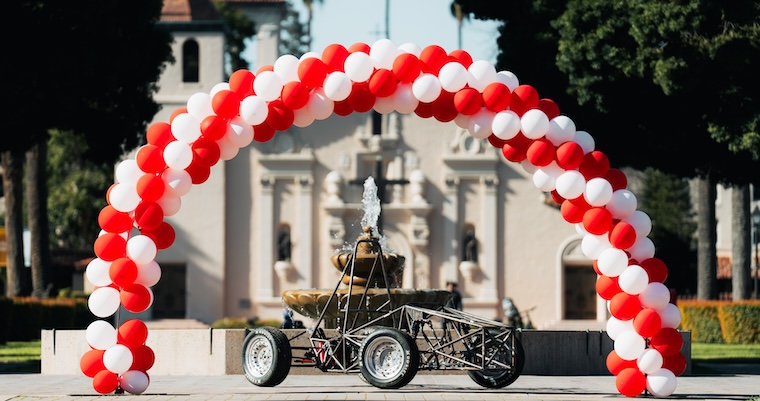
Budget concerns. Supply chain delays. Tariffs. Miscommunication between tech and business teams. Guidelines and deadlines. These issues occupy the mind of anyone who leads a complex business operation.
They occupy student Aiden Abarca’s mind, too. When he isn’t in a Leavey School of Business classroom studying finance and data analytics, he’s solving business problems. As co-captain of Bronco Racing, Santa Clara University’s Formula SAE Electric team, he manages the finances that take a $60,000 to $70,000 competition car from concept to design to manufacturing to the racetrack.
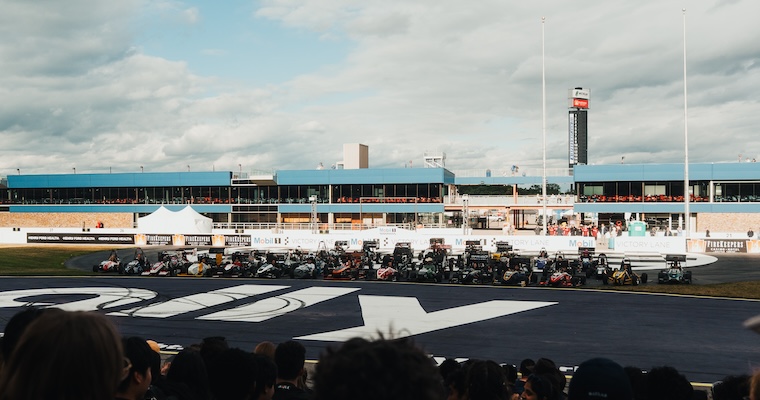
Formula SAE is a complex simulation of actual engineering and business pressure. Each year, cross-disciplinary teams of college students — engineers, finance experts, marketers and more — start with a set of guidelines for building a Formula 1 style car, an electric car in Bronco Racing’s case. Throughout a school year, they raise capital, design the car, deal with orders, set up manufacturing, and eventually travel to Michigan for rigorous speedway tests of the finished product.
If building a car in a school year sounds like a monumental task, it is. But the team’s students relish the challenge, not only because it’s fun but also because it’s real.
“Bronco Racing is not just case studies like you might do in other clubs,” Abarca says. “There are always these little day-to-day issues popping up. A sponsor just pulled out. This vendor just gave you a different quote that you didn’t plan for, and it messes up your entire ordering timeline.”
Learning to push through and solve those issues is critical to the experience. “I think it teaches you grit,” he says. “That's definitely what I’ve seen in myself, going from business lead to treasurer and co-captain.”
The Starting Line
Formula SAE has a 46-year history. Bronco Racing’s history is much shorter.
It started as an idea in roughly 2022. When Abarca joined in 2024, the team had yet to produce a car. It had, however, learned a great deal about what it takes to even start producing a car.
In 2025, his sophomore year, the team stepped up its organizational skills while setting a modest goal. They would take a car to Michigan International Speedway in spring 2026 for the competition. Getting that far would be a win, regardless of whether the car could pass the initial competition inspection.
They met their goal. Now, Bronco Racing is working on its second car for the spring 2027 competition and expanding its ambitions.
“The goal this year is to go to the competition, pass the technical inspection, and also get a lot of testing done,” Abarca says. “Passing tech is usually the biggest goal for any first- or second-year team.”
Going deeper in Formula SAE isn’t just a matter of competitive spirit. Both Abarca and teammate Lilian Krengel, a double major in engineering and economics who serves as business operations lead, point out that the competition provides valuable feedback for the future. The ruleset for Formula SAE changes every year, but lessons about technology and operations still carry over from year to year. That’s crucial for a young team that’s still building institutional knowledge.
Once a car in Formula SAE passes the technical inspection, it moves on to various tests on braking, withstanding G-force pressure, battery and fuel efficiency, acceleration and more. The further a team goes in the competition, the more testing they get. The more testing they get, the more helpful information they can pass on for future builds by future teams.
Even without much technical testing in their first year of competition, the team updated its business and training approach, says Krengel, who joined in 2025.
“In past years, there’s been a little bit of a disconnect between the business side and more technical side of things,” she says, “so one of my main goals this year was to come to each meeting with clear technical updates. We also started a development program in the fall to really teach new members the ins and outs of everything we do, rather than just throwing them onto the project.”
A Long Race
If Abarca and Krengel are any indication, Bronco Racing will grow and benefit from students who join the team early and then stick with it as long as they’re in school.
“I think I can speak for all the leads and captains and say it’s all I eat, sleep, and breathe,” Krengel says. “I really never run out of motivation.” A racing team seems a natural fit for someone who grew up in the Formula 1 hotbed of Austin, Texas, and who plans to put her skills to work in the aerospace industry. “I like things that go fast.”
Likewise, Abarca saw a Le Mans documentary as a child, and the idea of working with cars in some capacity has stuck with him ever since.
“The car comes first, no matter what, because we care about it,” he says. “People stay with this because they want to be working on this. It truly becomes their business.”
A realistic and immersive experience like Bronco Racing also stands out on a resume, Abarca adds. “There's always something to do every single day. It’s almost like a full-time job, day in and day out, all through summer break, all through winter break, all through Thanksgiving break, just to achieve this big project. I think that’s one of the biggest skills that employers really love about our club.”